Where to sell used designer bags: offers, fees and getting paid
Where to sell used designer bags depends on what you want to hand over: the bag, the work of finding a buyer, or control over the price. An outright purchase, a consignment agreement and a marketplace listing can all start with photographs. They leave you with very different commitments.
Start with an upfront buyer if you want to avoid managing a listing; consider consignment if you want someone else to handle the sale; list it yourself if price control matters enough to do the work. None guarantees the highest net return or a sale by a particular date. This is a seller's guide. Our pre-owned bag buying guide covers the other side of the transaction.
Examples below use the companies' English-language selling pages checked on 11 November 2026, with US-focused services and separately labelled UK fee evidence. They are not a worldwide eligibility or fee comparison. Confirm your residence, item location, currency and payout method before accepting. This is desk research, not a test consignment. Online Luxury Shops does not buy or sell bags and currently has no affiliate links.
Choose the transaction before the platform
| Route | What you hand over | Question before committing |
|---|---|---|
| Outright buyout | The item for an accepted purchase offer; no need to find its next owner yourself | Is the quote conditional on inspection, and when does cash reach my bank? |
| Trade or store credit | The item for spending power with a particular business | Would I choose the replacement purchase without the credit incentive? |
| Managed consignment | Possession and much of the sales work, while payment depends on a completed sale | Who controls markdowns, and what happens if I want the bag back? |
| Self-managed marketplace | Listing effort, negotiation and fulfilment responsibilities | What remains after fees, disputes and the time spent selling? |
| Local consignment or auction | An item under a specific shop or auction contract | What are the reserve, seller charges, unsold costs and settlement terms? |
FASHIONPHILE: an offer without managing a listing
FASHIONPHILE is a useful starting point for comparing an upfront purchase offer with doing the selling yourself. Its selling page describes online offers, in-person appointments and a Luxury Sales service. Availability and item acceptance need checking; an attractive bag is not automatically an eligible submission.
The online route asks for photographs and condition details. Its published sequence is offer, acceptance, sending the item, receipt and authentication, then funds in the FASHIONPHILE Wallet with a choice of payout or credit. A quote is therefore not money already in your bank. Store credit and gift-card incentives also differ from cash. It separately offers consignment: read which arrangement your offer actually proposes.
The trade-off is control: you avoid creating a public listing, but the offer reflects the buyer's own resale economics. Compare the final accepted cash amount with another eligible route using the same condition description. Our detailed profile explains its shopping interface and the distinction between its services.
Rebag: separate the quote from spendable cash
See the Rebag profile for buying, trading and selling routes.
Rebag's payment help page distinguishes buyout and consignment. For buyout, it estimates two to three weeks of processing after receipt, followed by approximately 40 business days for the payout to be added to the Rebag account. A bank transfer is a further stage, estimated at five to seven business days after an accepted request. These are estimates, not a promised completion date.
The same page states a 3% Early Transfer Fee for balances transferred within 15 calendar days of being added to the account, with free transfer eligibility after that period. For consignment it describes a pending sale period before confirmation and account credit. Check the applicable transaction terms as well as this help page. Our practical conclusion: do not choose this route on the draft's assumption of fast cash. Ask for a written explanation of your offer, acceptance conditions, payout stages and any charges before sending.
The RealReal: delegate the sale, read the pricing authority
See The RealReal profile for the buying and selling routes.
Managed consignment can suit a wardrobe clear-out when arranging individual listings would be a burden. The RealReal's agreement says it assigns the initial price and may apply discounts unless otherwise agreed in writing. Seller earnings depend on the net selling price and applicable commission rate; a headline maximum is not the share every bag earns.
Its agreement also describes eligible outright-purchase and trade-in options. Do not assume that every submission is consignment. Ask which model is being offered, what constitutes a completed sale, when payment is scheduled, and what it costs to retrieve an unsold item. Use its current accepted-designer directory before shipping; a brand's presence somewhere on the shopping site does not establish current seller eligibility.
List it yourself when control is worth the work
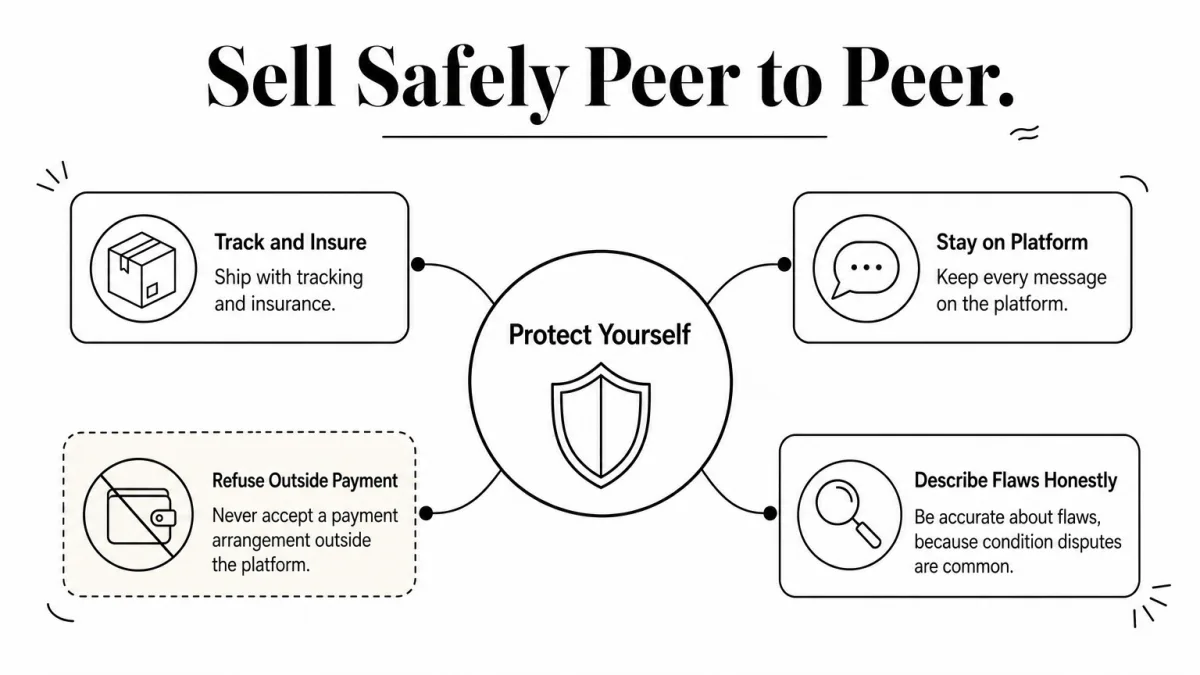
A self-managed listing gives you decisions to make about description, asking price and offers. It also leaves work: answering questions, documenting flaws, following shipping instructions and handling the platform's dispute process. A higher asking price does not prove a higher final payout.
Vestiaire Collective provides a concrete reminder to check the fee table rather than a generic headline. On the reviewed page, UK sellers listing in GBP face a 12% selling fee in the stated £83–£16,667 band, plus a 3% payment-processing fee. Other bands and currencies differ. Do not apply that UK example to a US-dollar listing. Read the fee preview and current seller terms for your own transaction.
Keep messages and payment within the chosen platform's supported process. Check whether authentication applies to the particular item and shipping route; do not treat a platform's reputation as proof that every transaction follows an identical procedure.
Local handover or an auction: get the contract first
A local appointment may let you discuss the bag in person. It does not by itself remove transport charges, insurance questions or commission. An auction may be worth investigating for a particularly unusual piece, but a photograph-based estimate is not a guaranteed result or an independent authentication.
Before leaving the bag, ask for an itemised receipt and written terms covering the reserve or minimum, markdown authority, seller charges, withdrawal, unsold return, loss or damage, buyer non-payment and settlement. Decide whether you can accept the lower end of the possible outcome, including the possibility of no sale.
Compare what you keep, not the listing price
Use a small worksheet: accepted cash offer or completed sale proceeds, minus applicable selling and processing fees, transport and other agreed costs. Keep credit offers in a separate column. Record when funds become withdrawable and whether a buyer return or dispute can delay completion. Do not count an unsold listing as proceeds.
- Photograph the exterior, corners, handles, hardware, lining and every flaw in clear light. Record repairs, odour, missing parts and the accessories included.
- Give each service the same description. Save the quote, expiry, inspection conditions and any revised offer.
- Share requested ownership documents through the service's secure process; redact unrelated personal and payment details. Do not publish full receipts or sensitive identifiers unnecessarily. A receipt alone is not proof of authenticity.
- Before dispatch, confirm the approved carrier, cover and claims conditions for this item's value. Keep packing photographs, an item list, the acceptance receipt and tracking.
- Keep the agreement through final settlement. If the amount changes, resolve the revised offer and any return cost before relying on the original quote.
If the question is where to find your next bag, switch to the buyer comparison or browse the fashion directory. See our editorial method and suggest a correction.
For a marketplace with private and professional sellers, see our Vestiaire Collective profile.
Sources & further reading
Source information reviewed on 11 November 2026. Details and regional terms can change; confirm them with the provider.
