Luxury shopping in Europe and shipping to the USA
To handle luxury shopping in Europe and shipping to the USA, follow four steps in order. Choose a seller that ships to the US, work out the full cost including VAT and US duty, verify authenticity and return terms, and confirm the shipping, insurance and signature options before ordering. Skip any of these and you risk a surprise bill, a stuck parcel or an item you cannot return.
The difficulty is that a price tag in euros tells you very little. Some European retailers remove VAT for US orders, some include US duty in the price, and some leave you to pay a courier at your door. Return policies for cross-border orders are often stricter than domestic ones. Shoppers also worry, reasonably, about a high-value parcel being lost or damaged on a long journey.
This guide starts with what changes when luxury crosses the Atlantic, then gives four steps you can act on. Online Luxury Shops is an editorial directory and does not sell products, so the advice here is about choosing and checking sellers, not promoting one. Always confirm current terms with the retailer and with US Customs and Border Protection (CBP) before you pay.
What changes when luxury ships from Europe to the USA
Buying from a European seller changes three things: the tax you pay, the customs process at the US border, and who you call when something goes wrong. Understanding these first makes every later decision easier.
Three ways to get the item home
You have three realistic routes, and each one decides who pays duty, who insures the parcel and who handles problems.
- Ship direct from the retailer. The seller dispatches to your US address with a courier. This gives you a single seller to contact about delivery and returns.
- Use a forwarding service. You get a European warehouse address, the shop delivers there, and the forwarder ships onward. It helps when a boutique only delivers within Europe. It also adds a middleman, so confirm the forwarder's insurance and that the item's authenticity card and receipt stay with it.
- Carry it home. Declare your purchases at the border and check whether you qualify for a traveler exemption. Baggage and shipped orders follow separate rules. The CBP travel guidance explains the current rules. Keep receipts and the original packaging.
Choose the route first, because it decides who pays duty, who insures the parcel and who you call when something goes wrong.
Why the price can differ from the US
EU shelf prices generally include VAT. Check the rules in the country where you shop. Many European retailers remove it on orders they ship outside the EU, and in-store tax-free schemes refund it to visitors, though minimum spends and paperwork vary by country. Currency swings and brand pricing policies also move the gap.
Do not assume Europe is cheaper. For some brands and items the difference disappears once duty and shipping are added. Compare on a landed-cost basis, meaning the total you pay to have the item in your hands, which Step 2 shows you how to calculate.
Step 1. Choose a seller that ships to the USA
Start with sellers that state clearly that they ship to the US and say who pays duty. A beautiful product from a shop that cannot deliver, or will not support a return, is not a bargain.
Match the seller type to the item
Seller types differ in sourcing, policies and what they can fix if something goes wrong.
| Seller type | Best for | What to check |
|---|---|---|
| Official brand website | Current-season pieces, brand warranty and repair access | US shipping, duty terms, return window |
| Multi-brand boutique or retailer | Wide choice from many designers in one basket | How it sources stock, how it handles returns |
| Department store | Familiar service, often with clear duty terms | International delivery and returns rules |
| Resale marketplace | Discontinued or pre-owned items | Authentication method, condition grading, return rights |
Check the checkout before you commit
Before you build a basket, look for answers to these questions, usually in the shipping and returns pages:
- Does the shop list the United States as a delivery country?
- Are duties and taxes included in the price, or collected on delivery?
- Which carrier does it use, and is the parcel insured?
- Who pays return shipping, and are refunds offered or only exchanges?
If a shop cannot answer in writing, treat that as your answer.
Find shops worth checking
Our directory profiles retailers and brands and separates official brand sites from multi-brand stores, so you can see what each destination offers before you start. Listings are selected destinations, not a guarantee of availability or authorization. Check delivery, returns, taxes and item condition with the retailer directly.
Step 2. Work out the full cost of European luxury shopping
Your real price is the shelf price minus any VAT removed, plus US duty, shipping, insurance and carrier fees. Calculate it before you pay, because it is what you compare against the US price.
The cost layers
| Cost | What decides it |
|---|---|
| VAT | Check the export checkout price or the separate traveler refund procedure |
| US duty | Tariff classification of the item and its country of manufacture |
| Shipping and insurance | Weight, speed, declared value |
| Carrier fees | Brokerage or handling charges when duty is collected on delivery |
Two details trip people up. Duty depends on where the item was made, not where you bought it, so a bag bought in Paris but manufactured elsewhere is classified by its origin. And tariff policy has changed repeatedly: as of this writing the US no longer waives duty on low-value parcels under the old $800 rule, so do not treat a parcel below that value as automatically duty-free. Check CBP for current rates, and ask the retailer or courier for an estimate.
A worked example
The rates below are assumptions for illustration only, not real tariff rates.
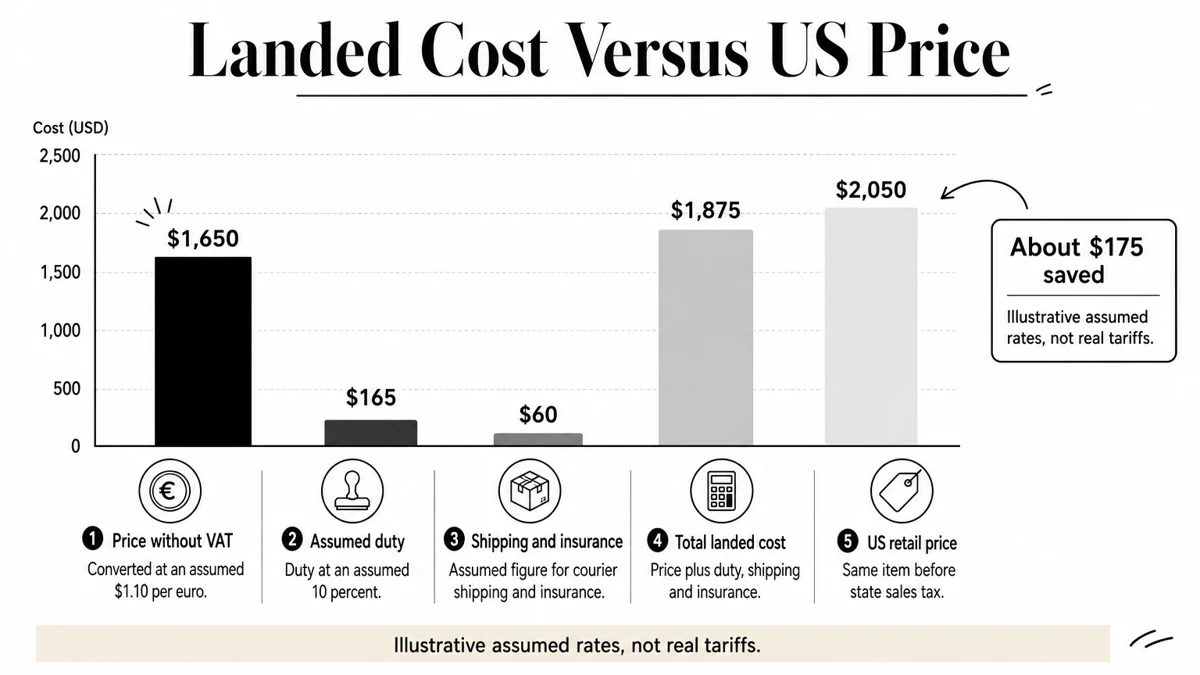
| Line | Amount |
|---|---|
| Shelf price in France, VAT included | €1,800 |
| Price without 20% VAT (€1,800 ÷ 1.20) | €1,500 |
| Converted at an assumed $1.10 per euro | $1,650 |
| Duty at an assumed 10% | $165 |
| Shipping and insurance (assumed) | $60 |
| Total landed cost | $1,875 |
If the same item costs $2,050 in the US, the difference in this example is $175 before any applicable sales tax, brokerage or currency conversion fees. Compare both totals after those costs. Change the duty rate or the exchange rate and that saving can shrink or vanish.
If you have not added VAT relief, duty, shipping and insurance together, you do not yet know whether buying in Europe saves money.
Duty paid or duty unpaid
A retailer that ships "duties paid" takes responsibility for duty under the stated shipping terms. Check which charges are included at checkout. With "duties unpaid," the courier bills you on delivery, often with a handling fee. For a high-value piece, ask the retailer or courier who will handle customs entry and which brokerage or handling fees are included.
Step 3. Verify authenticity and read the return terms
Check who is selling the item and how they will take it back, before you pay. Cross-border returns are slower and costlier than domestic ones, so the best return is the one you never need.
Confirm the seller and the sourcing
A convincing website proves nothing. Look for a verifiable business with a registered address, clear contact details and a history you can check. Use the brand's own store locator or ask the brand whether the retailer carries its products. Ask where the stock comes from and request close-up photos of stitching, hardware and labels.
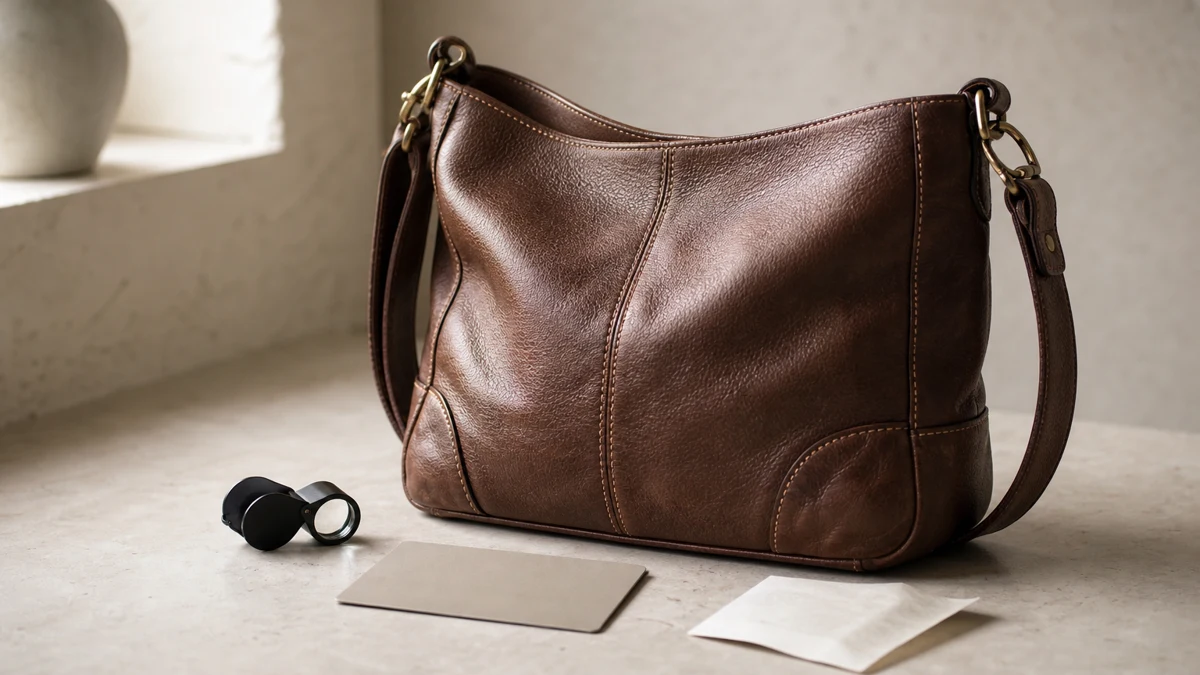
Treat prices far below the market, vague descriptions and reluctance to answer questions as warning signs. Pay by credit card where possible, since card issuers generally offer dispute procedures. A directory listing, including ours, is not a guarantee of authenticity for any individual item.
Check the seller’s sourcing and the evidence for the individual item. A receipt or authenticity card alone cannot establish authenticity.
Understand how returns work across borders
Ask whether an eligible return goes back to your original payment method and which charges the shop refunds. List merchandise, outbound shipping, return shipping, duties and taxes separately. Where the courier collected charges, ask it who handles any claim and what documents you need.
Before you buy, note the return window, whether items must be unworn with tags and packaging, and who pays return shipping. Get the required return label, authorization and customs instructions before dispatch.
Step 4. Ship, insure and receive the order
Ask about tracking, signature on delivery and coverage for loss or damage. Photograph the parcel when it arrives.
Pick the carrier and speed
| Service | What to confirm | Suits |
|---|---|---|
| Express courier (DHL, FedEx, UPS) | Actual estimate for your address and any customs processing time | High-value items, fast tracking, customs support |
| Standard international post | Tracking coverage, delivery estimate and insurance limits | Low-value items where speed matters less |
Customs clearance and holiday volumes can add days. Ask the retailer for the carrier's name and tracking number at dispatch.
Protect the parcel
Ask the seller to declare the full value and confirm the insurance covers it. Request signature on delivery and check whether it can be waived or redirected. Photograph the sealed box, any damage and the item itself as soon as it arrives, because those images support a claim against the carrier or seller.
Handle customs on arrival
The seller should include an accurate commercial invoice. Never ask for a lower declared value, because the declaration must accurately reflect the transaction. If duty is due, pay the courier's bill promptly. If tracking stalls or asks for documentation, contact the carrier through its official tracking page.
Shop Europe with the full cost in view
Buying luxury in Europe and shipping it to the USA works when you treat it as four decisions: a seller that serves US customers, a landed cost you have calculated, authenticity and return terms you have checked, and a shipment with tracking and coverage you have confirmed.
If you are still deciding where to buy, browse our directory of luxury shopping destinations to compare brand websites, multi-brand retailers and department stores, then confirm delivery, duty and return terms with the retailer you choose.
Compare the Mytheresa and LuisaViaRoma profiles, then check the terms for your US address. Suggest a correction.
Sources & further reading
Source information reviewed on 17 November 2026. Details and regional terms can change; confirm them with the provider.

